
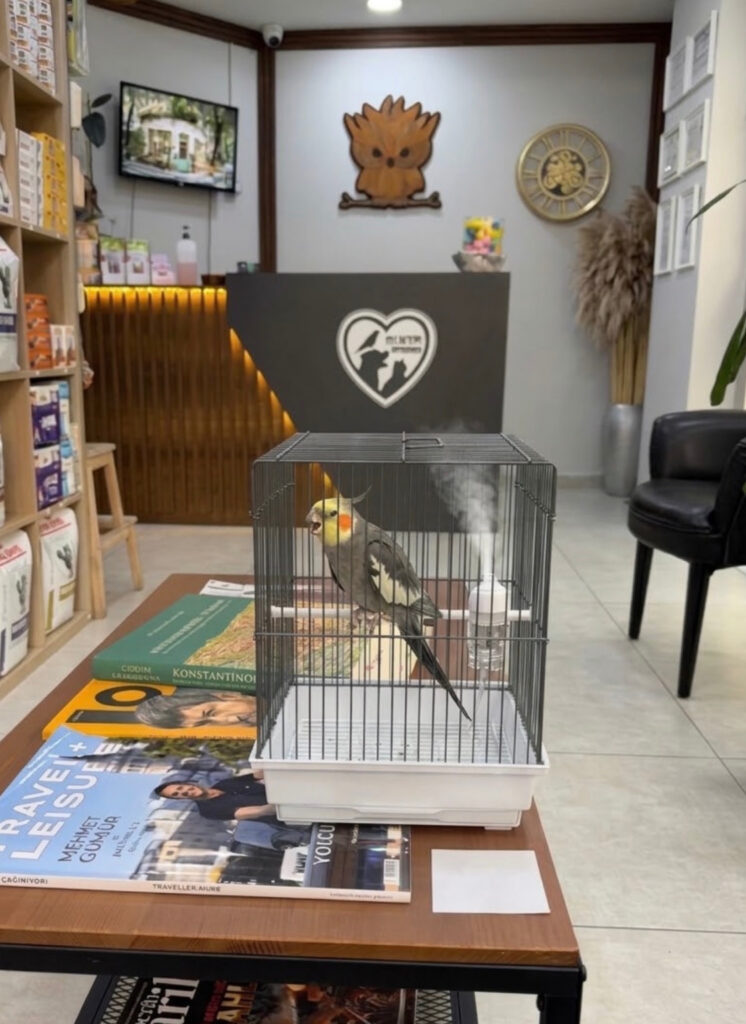
If your budgerigar is opening its mouth to breathe while resting, with its tail moving up and down noticeably with each breath, or making wheezing sounds while breathing, do not wait. Linking respiratory distress to "catching a cold" and waiting can be risky. Besides diseases of the airways, heart or reproductive system issues can also create a similar appearance. Continued open-mouth breathing while resting and evident effort to breathe require emergency veterinary assessment.
The budgerigar may still be eating or chirping occasionally. Do not delay seeking help based on this; reach out to the veterinarian without exhausting the bird. Medications and hot steam treatments attempted at home may worsen the situation.
How can you tell if a budgerigar is having trouble breathing?
A healthy budgerigar should breathe comfortably and quietly while at rest. Besides an increase in the number of breaths, noticeable movement of the body and tail during respiration is also evident. The signs to watch for include:
- Open-beak breathing while resting,
- Visible tail movement synchronous with each breath,
- Stretching the neck to attempt to breathe,
- Sudden wheezing, whistling, or clicking sounds,
- Change in vocalization, reduced chirping, or quick exhaustion while flying,
- Inability to perch, weakness, and descending to the cage floor.
Not all of these signs need to be present together. Especially, if respiratory distress is accompanied by instability or pronounced lethargy, it can be a serious situation that may even make manual handling of the bird difficult. Do not try to catch or fly the budgerigar repeatedly to check it.
Is tail movement always indicative of illness?
The tail may move while balancing, walking, and changing positions. What is important here is the noticeable up-and-down movement of the tail with each breath while the budgerigar is at rest. The bird might be exerting more effort to breathe. The cause of the movement will be investigated during examination.
Breathing may temporarily accelerate after flying or intense fear. However, if the difficulty continues despite calming down, restarts with slight movement, or is accompanied by open-mouth breathing, this should not be considered a normal resting response. The thought of “Let it fly a bit more, it will open up” may unnecessarily exhaust the bird.
Why does a budgerigar breathe with its mouth open?
Issues related to the respiratory tract and air sacs
Diseases of the nose, sinuses, trachea, lungs, or air sacs can affect breathing. Infections, mucus accumulation, and foreign bodies narrowing the airway are among the possibilities. In some budgerigars, nasal discharge or frequent sneezing may be observed. However, in lung or air sac diseases, the nose may appear completely normal.
The location of the wheezing sound and its quality can be helpful during examination. A diagnosis of “bacteria,” “fungus,” or “parasite” cannot be made just from a sound recording. Since treatments for different causes vary, using antibiotics indiscriminately is not the correct approach.
Narrowing of the trachea or external pressure can lead to a fine, whistling sound during breathing. Crop mycosis can slow down the emptying of the crop and create noticeable swelling. If these two signs are present together, the crop and airways are examined together; it is not correct to directly associate the whistling sound with crop mycosis. The cause of the sound will be determined through examination; do not squeeze or attempt to empty the crop.
For signs in the crop and diagnostic approach, you can refer to our article on crop mycosis in birds.
If there is crusting around the beak and nostrils, you can check our article explaining the differences between beak and foot mites and fungal infections. Do not delay seeking help by trying to clean off the crusts while there is respiratory distress.
Smoke, aerosols, and overheated coatings
Cigarette smoke, heavy-duty cleaning sprays, paint fumes, and similar inhaled substances are important. Gases from certain overheated non-stick coatings, caused by PTFE, can lead to severe and sudden respiratory problems in birds. The absence of a noticeable odor does not mean it is safe.
If exposure is suspected, move the budgerigar to a safe area with fresh air without putting yourself in danger and reach out to a veterinarian urgently. Inform them about the device or product used, the time of the incident, and whether there were other birds in the same environment. Ventilating the area does not substitute for examination.
Diseases outside the respiratory system
Heart diseases, anemia, fluid in the body cavity, or space-occupying formations can also make breathing difficult. In female birds, issues with the reproductive system and egg binding should be evaluated. If straining or inability to lay eggs is also present, the urgent signs in our article on egg binding in birds are important.
For this reason, palpating the bird's abdomen or attributing the problem solely to a respiratory infection is not safe. Identifying the cause requires a thorough evaluation of the entire bird.
What can you do until you reach the veterinarian?
When calling the clinic, clearly state, “My budgerigar is having trouble breathing while resting.” Describe the onset time, possible exposure to smoke or chemicals, and any medications used. If possible, you can record a short video without disturbing the bird; obtaining images should not delay seeking assistance.
Keep the budgerigar in a quiet, well-ventilated, and not overly hot environment. Minimize the risk of falling during transport; do not force it to fly to a high perch if it is unstable. Do not cover the transport container in a way that obstructs airflow. Avoid holding it tightly against the chest and frequently changing hands. Follow the guidance of the veterinarian you will consult regarding transport details.
Do not force-feed the budgerigar with food, water, or medication if it is having trouble breathing. Liquid entering the airways can worsen the situation. Do not attempt home remedies with boiling water steam, menthol products, essential oils, or inhalers meant for humans. It is also not appropriate to place the bird directly in front of a heater or confine it in a hot, airtight box.
How is diagnosis and treatment planned during examination?
The initial assessment often begins with observation in the transport container without physically touching the bird. In severe respiratory distress, it may be necessary to stabilize the condition first with oxygen and support suitable for the patient. Detailed examination and some tests may be postponed until the risks of manual handling are minimized; this does not mean the evaluation is abandoned.
Once the patient is sufficiently stabilized, blood testing, radiography, or infection investigations from appropriate samples may be planned according to the history and examination findings. The choice of tests depends on the bird’s condition and its ability to undergo examination. The identified cause determines the treatment; in follow-up, how the respiration and general condition have changed will be monitored. We explain in detail in our article on bird and exotic animal veterinary care why examinations are conducted differently in birds.
The examination process and application information can be found on our İstanbul Bird Veterineri service page.
Frequently Asked Questions
My budgerigar is eating, but breathing with its mouth open; can I wait?
No. Eating does not indicate that its breathing is sufficient. If it is breathing with its mouth open while resting, contact the veterinarian immediately; do not wait for a loss of appetite.
Can it be said that there is no respiratory distress if there is no wheezing?
No, it cannot be said. In some budgerigars, tail movement, neck stretching, or increased effort to breathe may be observed without a pronounced sound. Silence alone is not assurance.
Did this happen because my budgerigar was in a draft?
Direct hot or cold air currents are not suitable; however, saying “it was in a draft” does not replace a diagnosis. Infection, inhaled harmful substances, and causes outside the respiratory system must be differentiated.
Will giving steam or starting antibiotics at home be effective?
These are not safe first aid measures for unknown causes of respiratory distress. Improper application can increase stress, cause harm, and delay appropriate treatment. Medical applications like nebulization are planned by the veterinarian when necessary.
Can respiratory problems be transmitted to other birds?
Some infections can be transmissible; causes like smoke exposure or heart disease are not contagious. Report the common air, contact, and care conditions to the veterinarian. Whether other birds need evaluation and temporary separation depends on the cause.
This content is for general informational purposes; it does not substitute for a veterinary examination.

