
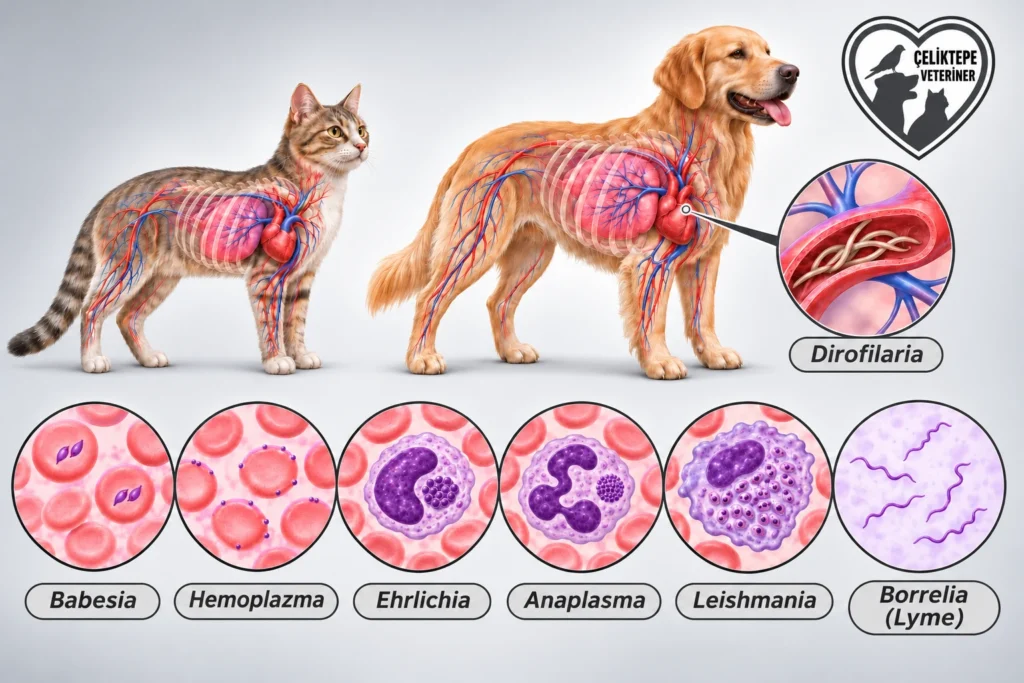
Your dog going for a walk as usual or your cat continuing to play does not always indicate that there is no infection in its body. Some diseases can appear suddenly with fever and lethargy, while others may go unnoticed for months. Sometimes the first sign may be a low platelet count in a blood test, sometimes it may be anemia or an effect starting in the kidneys.
"Blood parasite" is not the name of a single disease. In everyday usage, this term is used for different infections that can affect blood cells, blood vessels, and various organs. Babesia and Leishmania are unicellular parasites, heartworm is a nematode; Ehrlichia, Anaplasma, Lyme-causing Borrelia, and hemotropic Mycoplasma are bacteria. The routes of transmission, the diseases they cause, and their treatments differ from one another.
Carriers such as ticks, mosquitoes, and midges play an important role in the transmission of certain infections. Some agents can also be transmitted via infected blood transfusions or contact with blood. Therefore, prevention is not limited to the administration of a single parasite medication.
Why can blood parasites progress insidiously?
Infection does not mean disease. A cat or dog may not show symptoms for a long time despite encountering the agent. The immune system, the type of agent, the parasite load, and accompanying diseases affect how the disease will progress.
It cannot be said that every asymptomatic infection will definitely turn into a severe illness. However, it should be noted that an apparently healthy animal may also have an infection or be a carrier.
The absence of a tick does not definitively indicate that there has been no contact. Small ticks may go unnoticed among the fur, or they may have detached before the animal came for examination. The area where the animal lives, travels, contact with other animals, and the preventive products used are therefore important parts of the diagnosis.
Blood parasites seen in dogs and associated infections
Ehrlichia: Can present with low platelet count and bleeding
Ehrlichia canis is a bacterial agent transmitted through ticks in dogs. In the early stage, fever, loss of appetite, lethargy, and enlargement of lymph nodes may be observed. With the drop in platelet count, nosebleeds or small bleeding spots may form on the skin and gums.
In some dogs, no significant complaint may be observed for a long time after the initial stage. In severe chronic cases, the bone marrow's production of blood cells may be affected, leading to anemia, low platelet count, or a decrease in other blood cells.
In diagnosis, physical examination findings, blood count, antibody tests, and if necessary, PCR are evaluated together. Positive antibody results alone do not show that this infection is the cause of existing complaints or that antibiotics are needed in every case.
Doxycycline is one of the frequently used treatment options in clinical disease. Supportive treatment, and in some cases blood transfusions, may be necessary in patients with serious bleeding or anemia. Follow-up after treatment and tick control are important; a recovering dog can be reinfected.
Anaplasma: Fever, joint pain, and platelet changes
Anaplasma infections are also mostly transmitted by ticks. Different Anaplasma species affect different blood cells. Some dogs may exhibit fever, lethargy, loss of appetite, joint pain, and reluctance to move, while in others fluctuations in platelet counts may be more prominent.
Low platelet count is not solely caused by Anaplasma. Therefore, the diagnosis is made not only based on a single blood value, but also in conjunction with examination, blood count, antibody testing, and PCR results in the necessary cases. Appropriate antibiotic treatment is applied in clinical disease, and the response is monitored through general condition and blood values.
Lyme disease: A positive test does not always mean disease
Lyme disease is caused by bacteria in the Borrelia group and is transmitted through infected ticks. Most dogs exposed to the agent do not develop significant clinical illness.
When the disease develops, fever, joint pain, reluctance to move, and limping that can shift between legs may be observed. In rarer but severe cases, the kidneys may be affected. Therefore, evaluating urine analysis and protein loss in the urine is also important in some dogs.
A positive antibody test is a finding that the veterinarian must interpret together with examination and other tests. Not every positive dog automatically starts antibiotics. In clinical disease, appropriate antibiotic treatment is planned; regular tick control is a fundamental preventive measure.
Leishmania: A systemic disease beyond skin manifestations
Leishmania infantum is primarily transmitted through infected sandflies. Dogs may not show symptoms for months or even years following infection.
Weight loss, flaking, hair loss, non-healing skin sores, excessive nail growth, and swelling of lymph nodes may occur. The eyes may also be affected. The disease is not limited to the skin; especially kidney involvement is important for treatment and follow-up.
In diagnosis, antibody levels, PCR from appropriate samples, or the demonstration of the agent in tissues are used. Blood and urine examinations assess the changes caused by the disease in the body.
Treatment is determined according to the stage of the disease and organ functions. Clinical improvement does not always mean that the agent has been completely eradicated. Therefore, routine check-ups and protection against sandflies are important following treatment.
Heartworm: Transmitted by mosquitoes, affects lung vessels
The causative agent of heartworm disease is Dirofilaria immitis. It is transmitted through infected mosquitoes. Adult parasites are mainly found in the lung arteries; as the disease progresses, it may also affect circulation and the right side of the heart.
No symptoms may be observed in the early stages. Over time, coughing, rapid fatigue, weight loss, and shortness of breath may develop. In advanced cases, fluid accumulation in the abdomen or severe circulatory disorders may be observed.
In dogs, antigen testing and the search for microfilariae in the blood complement each other. Because a newly acquired infection may not be immediately detected in tests, the timing of testing is important.
Treatment is not limited to giving a single internal parasite medication. The severity of the disease is assessed; appropriate preparation, treatment targeting adult parasites, exercise restriction, and follow-up are planned. Uncontrolled treatment can lead to serious complications. The transmission cycle of heartworm requires considering contact with mosquitoes in the protection plan.
While heartworm can cause heart failure, it is not the sole cause of every heart failure. You can also refer to our article on heart failure in cats and dogs for more information on the subject.
Babesia: Anemia, jaundice, and dark-colored urine
Babesia species are unicellular parasites that infect red blood cells. In dogs, fever, lethargy, pale gums, jaundice, and dark-colored urine may be observed. The severity of the disease varies according to the Babesia species and the patient's overall condition.
Ticks are important in transmission. Infected blood transfusions and in some species, contact through bites can also be sources of infection. Especially for Babesia gibsoni, fighting and bite history are evaluated.
Observing the agent in blood smears assists in diagnosis; however, not seeing it in smears does not rule out infection. Species differentiation through PCR supports treatment selection. The same treatment protocol is not used for different Babesia species. Blood transfusions may be necessary in patients developing severe anemia.
Hepatozoon: A different route of transmission from tick bites
Hepatozoon canis infection can occur when a dog ingests an infected tick. It is important for the dog to swallow the tick while grooming itself or biting the tick off.
Some infections may progress mildly or asymptomatically. In cases where the agent load is high or accompanied by other diseases, fever, lethargy, and weight loss may be observed. Blood smears and PCR are utilized; treatment and follow-up are planned considering accompanying infections.
Blood parasites seen in cats and associated infections
Hemobartonella: Currently referred to as hemotropic Mycoplasma
Agents commonly known as "hemobartonella" in cats are now referred to as hemotropic Mycoplasma or simply hemoplasm. Mycoplasma haemofelis is one of the species that can cause significant anemia. "Candidatus Mycoplasma haemominutum" and "Candidatus Mycoplasma turicensis" may also be found in cats.
In infected cats, lethargy, loss of appetite, pale gums, and sometimes jaundice may be observed. However, there are also asymptomatic carrier cats.
The natural routes of transmission have not yet been fully explained. Transmission through infected blood transfusion is possible; fighting and contact with blood are considered potential routes. It is not accurate to say that fleas have been definitively identified as a route of transmission for this infection.
PCR is the preferred method for investigating hemoplasmas. Results are interpreted together with anemia and other clinical findings. In clinical disease, appropriate antibiotic treatment and, if necessary, blood transfusions are applied. Improvement of symptoms does not always indicate the complete cessation of carrier status; healthy carriers are not automatically given antibiotics.
Babesia in cats
Babesia infection can also occur in cats. However, the distribution of species and the frequency of the disease in dogs should not be directly transferred to cats. The significance of babesiosis in cats varies depending on geographical region and agents.
Lethargy, anemia, weight loss, and jaundice may be observed. Because these symptoms may also be associated with hemoplasma infections and other diseases, diagnosis cannot be made solely based on external signs.
Blood examinations and, if necessary, PCR to investigate the agent, with an attempt to identify the species when possible, are important for treatment. The Babesia treatment applied to dogs is not directly adapted to cats.
Heartworm in cats
Heartworm infection can also be seen in cats through mosquitoes. Although there may be few parasites in cats, serious lung and respiratory problems may develop. Symptoms such as coughing, difficulty breathing, or signs resembling asthma may be observed.
A negative antigen test alone does not rule out the disease in cats. Antibody and antigen tests, imaging, and clinical findings may be assessed together in diagnosis. The adult heartworm treatment applied to dogs is not applied the same way to cats. Therefore, an appropriate preventive program is especially important for cats.
Cytauxzoon, Bartonella, and other agents
Cytauxzoon species can cause blood and tissue-related infections in cats. The course and significance of the disease vary according to the type of the agent and geographical region. High fever, anemia, jaundice, and rapidly deteriorating general condition are assessed along with travel and living area history.
Bartonella is a bacterium, not a parasite. Cats can be carriers without showing symptoms. The transmission cycle associated with fleas and flea droppings is significant. Some species of Bartonella are associated with cat scratch fever in humans; therefore, flea control and cleaning of scratch wounds are important.
Anaplasma and Ehrlichia infections have also been reported in cats; however, the frequency and clinical picture in dogs should not be directly transferred to cats.
How do blood parasites transmit? What are the sources of contamination?
There is no single route of transmission that applies to all agents:
- Tick contact: It is important in Ehrlichia, Anaplasma, Lyme, and many Babesia infections.
- Midge: It is the main carrier of Leishmania.
- Mosquito: It plays a role in the transmission of heartworm.
- Infected blood: Some agents can be transmitted through blood transfusions or blood-contaminated equipment.
- Fighting and bites: Present a risk of blood contact in some infections.
- Fleas and flea feces: Particularly important in the transmission cycle of Bartonella.
- Ingestion of an infected tick: A separate route of transmission for Hepatozoon.
Using the same food or water bowl, being in the same room, or sharing the same litter box is not a common and usual route of transmission for all these diseases. The precautions to be taken depend on the identified agent if there are other animals in the house.
What symptoms may be observed?
Although diseases may progress differently, the following findings can be observed in blood parasites or associated infections:
- Lethargy, loss of appetite, and weight loss
- Recurring or persistent fever
- Pale gums and anemia
- Nosebleeds or small bleeding spots on the skin
- Jaundice and dark-colored urine
- Joint pain, limping, or reluctance to move
- Coughing, rapid fatigue, and difficulty breathing
- Skin sores, hair loss, or swelling of lymph nodes
These symptoms are not exclusive to blood parasites. Especially significant paleness, jaundice, difficulty breathing, persistent bleeding, fainting, or rapidly worsening lethargy require emergency veterinary evaluation.
How is the diagnosis made?
Diagnosis is based on the overall assessment of the patient rather than the result of a single test. Home environment, travel, tick or fly contact, used preventives, blood transfusion, and history of fighting are investigated.
Complete blood count provides information about anemia, low platelet counts, and changes in white blood cells. However, it does not always indicate which agent is present by itself.
Blood smear can allow for the direct observation of some agents. Not seeing the agent in the smear does not definitively rule out infection.
Antibody tests can indicate that the animal has been exposed to specific agents. A positive result does not always mean active disease. The results may still be negative in the very early stages of infection.
PCR investigates the genetic material of the agent in the sample. The timing of sampling, previously administered medications, and the amount of the agent in the sample can affect the result. Not every PCR panel covers all agents.
When necessary, organ involvement is evaluated through biochemical analysis, urinalysis, measurement of protein loss in urine, and imaging techniques. Particularly in diseases that can affect the kidneys, monitoring kidney function is important. You can also find information about our laboratory and advanced diagnostics services.
How is treatment planned?
There is no single medication or duration of treatment that is suitable for all patients with blood parasites. The treatment is determined according to the identified agent, the type of animal, the stage of the disease, blood values, and the status of the organs.
While antibiotics are used in some bacterial infections, different treatment approaches are necessary for Babesia, Leishmania, and heartworm. Blood transfusions, fluid therapy, and hospitalization may be required in patients with severe anemia or bleeding.
Response to treatment is not assessed solely by the opening of appetite or the lowering of fever. Blood counts, organ functions, and other tests, when necessary, are followed at specified intervals. In some infections, even if symptoms improve, carrier status may continue; in some cases, re-infection is also possible.
What should be done for prevention?
A regular prevention plan should be prepared based on the type, age, weight, living environment, and travels of the animal.
- Apply the appropriate product against ticks and fleas at intervals recommended by your veterinarian.
- Ensure that the preventive used for heartworm risk is genuinely suitable for this agent. Not every internal parasite product provides protection against heartworm.
- Evaluate appropriate preventive measures against sandflies in areas with Leishmania risk.
- Check the fur and skin for ticks after walks and outdoor contact.
- Ensure that blood donors are screened for appropriate infections and that sterile equipment is used.
- Do not apply products prepared for dogs to cats. Especially some dog products containing permethrin can cause serious poisoning in cats.
- Do not neglect the recommended check-ups for animals that have had the disease.
Not every product offers the same protection against every vector. Preventive healthcare applications should be planned according to individual risks. You can access detailed information about flea problems in cats from our article on flea problems in cats.
For the routes of transmission and prevention steps for intestinal parasites, you can also check our article on intestinal parasites in cats and dogs.
Frequently asked questions
1. Can a cat or dog with a blood parasite appear healthy?
Yes. In some infections, an animal may not show symptoms for a long time. However, not every healthy animal requires the same tests; the decision to screen is made based on living conditions and risks.
2. Can an indoor cat have a blood parasite?
Yes. Mosquitoes or other carriers entering the house, other animals in the home, past contacts, and blood transfusions are evaluated according to the agent. The risk depends on living conditions; not every indoor cat has the same risk.
3. I didn't see a tick. Could my dog still have a tick-borne illness?
Yes. The tick may have been unnoticed due to its small size or may have detached later. Diagnosis considers not only the presence of a tick but also the symptoms and test results.
4. If the blood count is normal, can a blood parasite be definitively excluded?
No. In some infections, the blood count may be normal. The necessary tests are determined based on examination, exposure history, and suspected agents.
5. Does a rapid test show all blood parasites?
No. Each rapid test or PCR panel investigates only certain agents. A negative result should be interpreted considering the test scope and the timing of the sample collection.
6. Can blood parasites transmit to humans?
It varies according to the agents. In some diseases, humans and animals may be exposed to the same tick or insect; in some agents, different routes of transmission are significant. Touching an infected animal is not a common route of transmission for all these diseases. Once the agent is identified, necessary precautions for the household are assessed separately.
7. Does a blood parasite pass from one cat or dog to another through a food bowl?
Using the same food or water bowl is not a common route of transmission for all the infections described here. The risk varies based on vector, blood contact, and the characteristics of the identified agent.
8. Do internal or external parasite medications protect against all blood parasites?
No. The parasites and vectors covered by products differ. Tick or flea products are not always effective against mosquitoes or sandflies. Similarly, not every internal parasite treatment provides protection against heartworm.
9. How often should external parasite treatment be done?
The frequency depends on the duration of action of the product, the type of animal, and the risk in the area. Products are not used at the same intervals; the program recommended by the veterinarian should be followed.
10. Do blood parasites recur after treatment?
Failure to completely eradicate the agent, reinfection, or accompanying diseases may lead to the reappearance of symptoms in some cases. Therefore, it is important to have follow-up and continue prevention after treatment.
11. How much does blood parasite testing and treatment cost?
The cost varies depending on the necessary tests, the identified agent, the severity of the disease, and whether hospitalization or blood transfusions are needed. It is not correct to state a single fee for all patients before examination and necessary investigations are determined.
Veterinarian Miraç Gürbüz
Çeliktepe Veterinary Clinic
This content is for general informational purposes; it does not replace a veterinary examination.

