
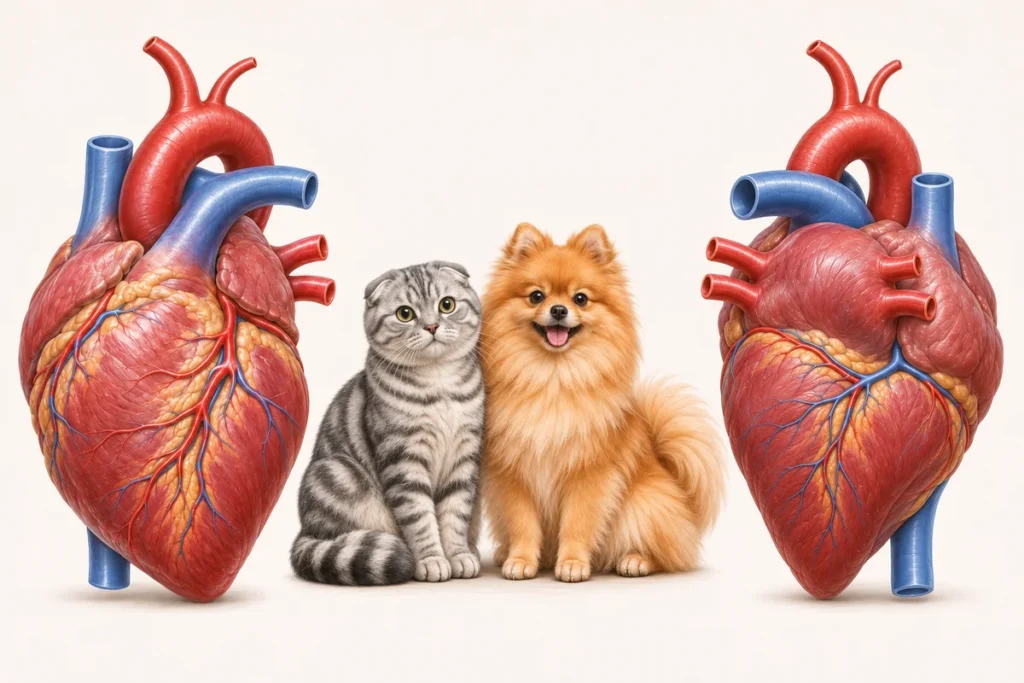
Imagine a new cat arriving home. It explores the food bowl, settles on the couch, and wants to play in the evenings. From the outside, there’s no reason to suspect any health issues. Or consider your dog that you've walked in the same park for years: Recently, it has been slowing down a bit on the way back. It's easy to attribute this to age, the weather, or lack of enthusiasm.
Heart diseases can sometimes start quietly like this. However, not every instance of fatigue indicates heart disease; and not every heart disease implies heart failure. The crucial point is knowing which changes need to be investigated and which signs should not be overlooked.
Even in the absence of symptoms, the heart of every newly adopted cat and dog should be evaluated during their first veterinary examination. Listening to the heart and lungs, checking pulses, taking a history, and considering breed-specific risks are components of this initial assessment. In cases deemed necessary, further examinations may include echocardiography, Doppler, EKG, and blood tests. The way to identify silent diseases is not merely to wait for symptoms.
First, let’s recognize emergency symptoms
Do not delay seeking help in the following situations:
- Difficulty breathing at rest, using abdominal muscles to breathe, or cyanosis.
- Open mouth breathing in a cat.
- Sudden collapse, fainting, or rapidly worsening obvious weakness.
- Especially in cats, sudden inability to use one or both hind legs, accompanied by severe pain and cold paws.
The cause of these symptoms may not always be the heart; nonetheless, an urgent evaluation is necessary. Keep the animal as calm as possible, do not force water or food, and do not administer medication without veterinary guidance. Do not tightly wrap a patient having difficulty breathing. When seeking help at the nearest suitable veterinary center, if possible, provide information by phone. You can find pre-visit information on our Emergency Veterinary and Critical Care Support page.
Is heart disease the same as heart failure?
Heart disease can involve the valves, heart muscle, rhythm, or congenital structural features. Heart failure is the clinical condition arising when the heart's function is impaired, leading to circulation problems. Fluid accumulation in lung tissue, fluid collection in the chest cavity, or abdominal fluid accumulation may occur in some patients.
Thickening of the heart wall does not necessarily mean a stronger heart. Likewise, an enlarged heart does not alone indicate the name or treatment of a disease. It must be determined where, why, and to what extent the changes have occurred.
It is possible for an animal to have a structural heart disease and show no symptoms for years. Conversely, a previously undetected disease may become apparent for the first time with serious respiratory distress or thromboembolism. The value of early diagnosis is not merely starting medication immediately for every patient but rather discerning who should only be monitored and who requires closer follow-up or treatment.
Heart diseases in cats: What could be behind the silence?
One common issue in cats is hypertrophic cardiomyopathy, or HCM. Thickening of the heart muscle can particularly interfere with the heart's ability to relax and fill with blood. However, seeing thick walls on ultrasound alone does not complete the assessment. Other causes, such as high blood pressure and hyperthyroidism, are also investigated.
The fact that a cat is still eating or playing occasionally does not guarantee its heart is healthy. Some cats may not have a heart murmur detectable. In others, a murmur may be heard, yet no significant structural disease may be identified. Therefore, listening with a stethoscope is a very valuable starting point but not the final answer to every question.
Genetic predispositions associated with HCM have been well defined in Maine Coons and Ragdolls. However, the disease does not affect only purebred cats; it can also be observed in domestic or mixed-breed cats. Genetic testing results do not replace veterinary examinations and, if necessary, heart ultrasounds.
Heart diseases in dogs: Valve, muscle, or rhythm?
Degenerative mitral valve disease is commonly seen, especially in small breed and older dogs. When the valve does not close completely, some of the blood flows backward. Initially, a murmur may only be audible during a physical examination; over time, this can lead to dilatation in the heart's chambers.
Breeds such as Cavalier King Charles Spaniel, Dachshund, and small Poodles should be monitored carefully for this disease. Breed predisposition does not mean every individual will become ill at the same age or weight.
In dilated cardiomyopathy, or DCM, the heart muscle's contraction strength decreases, and the heart chambers can enlarge. Some large breeds like Doberman Pinschers and Great Danes are particularly affected. In Dobermans, arrhythmias can become significant even before obvious heart enlargement is noticed. Arrhythmogenic heart disease, which can occur in Boxers, also requires separate evaluation; it is incorrect to group all large breed heart problems under a single heading.
In young animals, congenital heart diseases may be a concern. Therefore, heart check-ups are not just needed for older cats and dogs.
Why should you not postpone heart examination at the first adoption?
With a new pet coming home, the health agenda often revolves around vaccinations, internal and external parasite treatments, and nutrition. Heart assessment should not be omitted from this initial examination. Previous health records, quick fatigue, syncope, changes in respiration, and any known family history of heart disease should be shared.
Two separate concepts must be distinguished here: An initial examination is important for every animal; it is not necessary to apply the same advanced testing package to every healthy animal. Findings such as murmurs, abnormal rhythms, unexplained symptoms, breed predispositions, or family history reinforce the need for echocardiography. In a high-risk patient, pre-anesthetic assessment will also be planned accordingly.
For example, simply listening to the heart is not sufficient for screening silent DCM in Dobermans. Breed-specific recommendations include echocardiography and Holter monitoring; it should also be noted that a normal examination does not provide lifetime assurance.
When obtaining information about cardiology assessments at Çeliktepe, sharing your pet's age, breed, previous examination findings, and medications will facilitate planning the necessary evaluations.
Which signs raise suspicion regarding the heart?
In dogs, decreased willingness to walk, inability to sustain previous exercise, rapid breathing at rest, fainting, and in some cases, coughing stand out. However, coughing alone does not diagnose heart failure. Respiratory diseases are also among frequent causes.
Symptoms in cats may be more subtle: decreased activity, hiding, decreased appetite, or reluctance to go to places they normally would is observed. Rapid and difficult breathing is crucial in heart failure; coughing is not as typical a sign of heart disease in cats as it is in dogs. In a coughing cat, other conditions like asthma should also be investigated.
Interpreting these changes as simply “aging” may conceal a problem that could be investigated. On the other hand, it is also incorrect to attribute every behavioral change to the heart. The starting point for a diagnosis is a good history that describes when the change started and under what conditions it was seen.
Why are echocardiography and Doppler centrally important?
Echocardiography is the ultrasound examination of the heart. The heart walls, chambers, valves, and movements are evaluated. Doppler methods provide information regarding the direction and speed of blood flow and contribute to assessing problems such as valve leakages or obstructions to flow.
When referring to “heart ultrasound,” it is not about a regular abdominal ultrasound. Correct images must be obtained, and measurements must be interpreted alongside the pet's species and body characteristics. Ultrasonography and Color Doppler studies are therefore planned in conjunction with clinical evaluations.
Echocardiography is one of the fundamental tools for structural diagnosis; however, it does not replace all tests. EKG assesses electrical rhythm, and Holter evaluates intermittent arrhythmias throughout the day when necessary. Chest X-rays and, in appropriate cases, lung ultrasounds help investigate fluid accumulation accompanying respiratory distress. Blood pressure measurement and blood tests complete the examination.
In a patient having difficulty breathing, it may be more appropriate to ensure safe stabilization rather than trying to complete lengthy examinations. The order of tests is determined according to the patient's current condition.
What do Troponin I and NT-proBNP tests indicate?
Cardiac Troponin I: A marker for heart muscle damage
Cardiac troponin I, denoted as cTnI, is a biomarker used to assess heart muscle cell damage. Its elevation is significant; however, it does not independently indicate the cause, stage, or which medication to use. The common idea in humans that “high troponin equals a heart attack” cannot be directly applied to cats and dogs.
The result must be interpreted alongside clinical findings, accompanying diseases, and the tests and imaging used. A normal result does not rule out all heart diseases.
NT-proBNP: A hint of cardiac wall tension
NT-proBNP is a biomarker associated with increased wall tension in the heart. In appropriate patients, it can help to evaluate the suspicion of heart disease and especially investigate the relatedness of respiratory issues to the heart.
However, blood results do not show the thickness of the heart wall or the nature of valve leakage. In mild disease, the result may be normal; factors such as kidney function are also considered in the interpretation. For cats and dogs, the thresholds among different testing methods should not be considered the same.
In summary, troponin helps answer the question, “Is there a sign of damage in the heart muscle?”, while NT-proBNP addresses, “Is there a sign of increased tension in the heart?”. These two tests do not replace each other or Doppler echocardiography. Laboratory and Advanced Diagnostics results gain meaning when considered alongside examination and imaging findings.
Thromboembolism in cats: Why sudden inability to walk is an emergency?
In some heart diseases, especially when the left atrium is enlarged, blood clots may form. If a clot detaches and blocks an artery, this is termed arterial thromboembolism. The scenario affecting circulation to the hind legs is particularly significant in cats.
A cat might suddenly cry, drag its hind legs, or be unable to stand. Its paws may become cold. Sometimes only one leg is affected. In such cases, waiting until the morning thinking it's just an injury is dangerous.
Thromboembolism can be life-threatening; if it occurs alongside heart failure, the situation may become even more severe. However, the outcome is not the same for every patient. The initial assessment, pain control, circulation, and respiratory status along with treatment response are considered together. Giving aspirin at home, rubbing a painful leg, or waiting for spontaneous resolution is not appropriate.
Treatment to reduce the risk of clots is not automatically applied to all cats. Risky heart findings or a history of thromboembolism dictate the veterinarian's decision.
Treatment is planned based on the patient's condition, not the name of the disease
Not every animal diagnosed with heart disease receives the same prescription. The needs of a symptomless dog with valve disease are different from those of a cat with fluid accumulation in its lungs.
For example, studies have shown that for some dogs with mitral valve disease, treatments that can be initiated before heart failure develops provide benefits when specific heart enlargement criteria are met. This information does not imply that medication will be started for every dog that has a murmur heard or that the same approach will be applied to cats.
In heart failure, medications that reduce fluid accumulation, treatments supporting the heart's function in selected patients, rhythm control, or medications to reduce the risk of clots may come into play. Fluid in the chest cavity may require a different intervention.
During evaluations, it is not only the heart that is examined. Kidney values, hydration, blood pressure, and electrolytes are also important. Especially sodium, potassium, and chloride levels may change depending on the disease and medications used. Stopping medication on your own, increasing the dosage, or using the treatment given to your neighbor's pet is not safe.
How should nutrition and diet be adjusted in heart disease?
The aim of nutrition is not merely to reduce salt intake. The patient must receive sufficient energy, maintain muscle mass, and consider any accompanying diseases. A strict diet that is poorly consumed in an animal with decreased appetite or weight loss can create additional issues.
The level of sodium restriction is determined by the stage of the disease. Salami, sausage, salty cheese, and other table foods, along with morsels used to hide medications, can increase daily sodium intake. Treats must also be considered just like regular food.
Choosing a renal diet solely because of heart disease is not automatic. When heart and kidney issues coexist, the balance of energy, protein, phosphorus, and sodium must be planned specifically for the patient. Access to water should not be restricted at your discretion.
Taurine is an essential nutrient for cats; however, not every heart disease is caused by taurine deficiency. Uncontrolled supplementation cannot replace a diagnosis. Research related to DCM associated with diet in dogs cannot be reduced to a simple statement that “gram-free diets cause heart disease.” The full name of the food being used and the nutritional history should be shared with the veterinarian.
Home monitoring: What can the breaths taken while sleeping indicate?
Watch your pet's chest rise and fall while it is calm and sleeping. One rise and fall count as one breath. You can count for thirty seconds and multiply by two. Counting while your cat is purring or your dog is panting due to heat is not interpreted in the same way.
The respiratory rate during sleep in many healthy or well-controlled animals is below 30 breaths per minute. A single measurement does not provide a diagnosis. A persistent increase relative to its normal value or repeated high counts should be shared with the veterinarian; especially a personal warning threshold should be determined in heart disease.
If the effort to breathe has increased, if the animal is unable to lie comfortably, or if it is breathing with its mouth open, do not delay seeking help to count breaths. Keeping a notebook for recording appetite, medication times, activity, and weight changes will also make follow-ups more efficient.
Frequently asked questions
1. Can my cat have heart disease without showing symptoms?
Yes. Especially some heart muscle diseases can present silently. A normal appetite and eagerness to play do not negate the need for necessary heart evaluations.
2. Is heart check-up really necessary at the first adoption?
Yes. A comprehensive first examination that includes resting assessment of the heart and lungs is a crucial part of preventive health. The need for advanced testing is determined based on this evaluation.
3. Should every cat and dog necessarily have a Doppler echo done?
A universal testing package is not suggested for everyone. Breed, family history, examination findings, and symptoms are evaluated. Absence of symptoms in a high-risk patient is not a justification for postponing the echo.
4. Does not having a murmur prove that the heart is healthy?
No. Structural diseases, particularly in cats, can be found without a murmur. Necessary examinations are not determined solely based on heart sounds.
5. Does every animal with a murmur have heart failure?
No. A murmur is a finding during examination. Its source, relationship to structural changes, and clinical significance are investigated.
6. Are HCM and heart enlargement the same thing in cats?
No. HCM is a specific heart muscle disease. “Heart enlargement” is a general term that does not specify a cause by itself.
7. Does elevated troponin I indicate a heart attack?
Not by itself. It is a finding suggestive of heart muscle damage; the underlying cause must be understood by evaluating the overall condition of the patient.
8. If NT-proBNP is normal, can heart ultrasound be skipped?
Not always. A normal result is possible in mild disease. If examination or history is suspicious, imaging may be necessary regardless.
9. Does elevated NT-proBNP alone initiate medication?
No. The meaning of elevation is determined in conjunction with species, test method, concomitant conditions, and imaging.
10. What is the difference between echocardiography and EKG?
Echocardiography examines structures and movements, while Doppler assesses blood flow; EKG examines the electrical activity of the heart. They complement each other.
11. Why is Holter requested?
It can help capture intermittent arrhythmias not visible during short EKG recordings. It is particularly valuable in appropriate risk groups or unexplained fainting cases.
12. If my dog is coughing, is it certainly a heart disease?
No. There are many causes of cough related to the respiratory tract. Even in a dog with heart disease, not every cough is due to heart failure.
13. If my cat is not coughing, can heart failure be ruled out?
No. Heart failure in cats can emerge with rapid or difficult breathing; waiting for a cough is misleading.
14. My cat suddenly cannot use its hind legs; what should I do?
An emergency veterinary evaluation is required. Particularly, pain and cold paws may suggest circulatory disturbances due to a clot; waiting at home can waste precious time.
15. Is thromboembolism necessarily fatal?
It is a serious life-threatening condition, but the outcome is not the same for every patient. The affected circulation, accompanying heart failure, and treatment response are important factors.
16. Can I give aspirin at home to prevent clotting?
No. Medication selection and dosage are specific to the patient. Uncontrolled use of human medications can lead to poisoning or bleeding.
17. How long does a dog or cat with heart failure live?
It is not correct to give a duration without knowing the examination and stage of the disease. The type of disease, complications, and response to treatment should be evaluated together.
18. If the condition improves with medication, can treatment be stopped?
It should not be stopped spontaneously. A decrease in symptoms may not indicate that the disease has completely resolved; changes should be planned by the veterinarian.
19. Should a heart disease animal refrain from moving?
Activity level is individualized. In stable patients, appropriate movement is not the same as strenuous exercise. If there is fainting, difficulty breathing, or obvious fatigue, activity should be stopped, and evaluation should be performed.
20. Can heart diet and kidney diet be used interchangeably?
They cannot be used automatically. The dietary goals of the diseases may differ; if they coexist, a common plan is needed.
21. Should the water intake of a heart disease patient be reduced?
Water should not be restricted without specific veterinary guidance. This approach can be risky, especially in patients using diuretics.
22. Does taurine supplementation correct every heart disease?
No. Diseases associated with taurine deficiency are evaluated separately. Not all cases of HCM or DCM have the same underlying cause.
23. If the genetic test is negative, is another check necessary?
It may be necessary. Tests investigate known specific changes; they do not rule out all heart diseases or the risk in later life.
24. Is heart disease a definitive contraindication for anesthesia?
Not always. The necessity of the procedure, severity of the disease, stabilization, and appropriate anesthesia plan should be evaluated together. Diagnosis must be communicated to the team administering anesthesia.
25. What should I bring when going for a heart check-up?
Bring previous laboratory and imaging reports, names and dosages of medications, the full name of the food, and if available, videos of fainting or breathing. Recording the video should not delay the emergency visit.
Establish a starting point rather than waiting for symptoms
The purpose of a heart examination is not limited to searching for a disease in every seemingly healthy animal; it is to create a reliable initial evaluation for your companion. Bring heart health into consideration during the new adoption examination. Share changes in activity levels, breathing, and appetite in the following years. If a disease is detected, clarify not just the prescription but also the follow-up date and the path you'll take in an emergency.
When seeking a General Examination and Internal Medicine evaluation at Çeliktepe Veterinary Clinic, do not postpone the first adoption check-up even if you see no symptoms. Good monitoring sometimes begins when there are no complaints to report yet.
Veterinarian Miraç Gürbüz
This content is for general informational purposes and does not replace a veterinary examination.

