
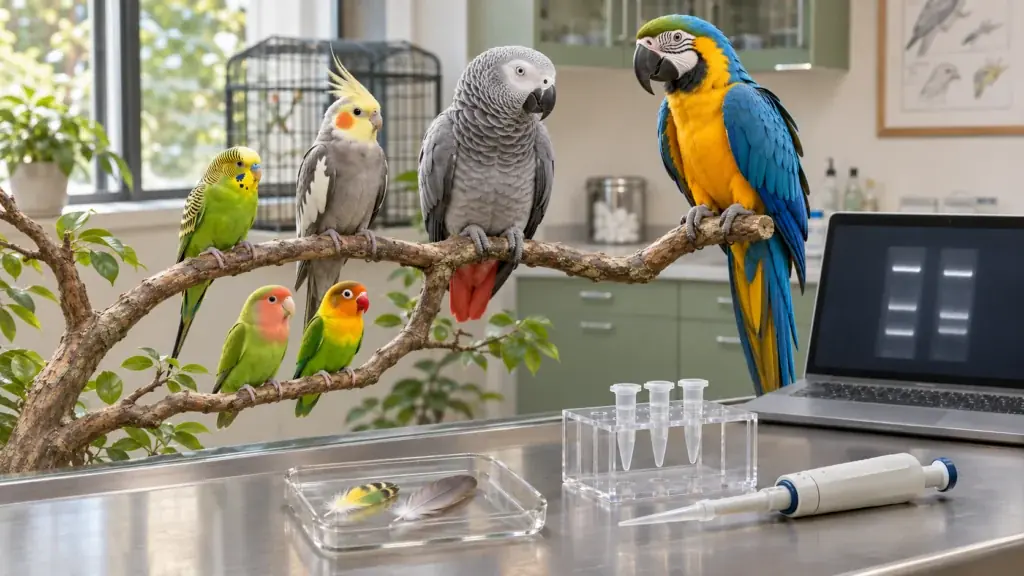
Your budgerigar may have a pink cere, your cockatiel might have a striped tail, and your African Grey may have a broad head. The value of these three observations for sex determination is different for each. The cere color in budgerigars, age and feather patterns in cockatiels can be helpful. However, it is difficult to reach a reliable conclusion based on appearance in African Greys and most lovebirds. First, the type of bird should be assessed, followed by age and color variety.
Which clue works for which bird?
| Bird | Features to observe | When to consider DNA testing? |
|---|---|---|
| Budgerigar | Cere color on the upper beak and the area around the nostrils | If the bird is a chick, if color variety interpretation is difficult, or if the cere appearance is atypical |
| Cockatiel | Patterns on the face, underwing, and undertail after the first adult molt | If the bird is still in chick plumage or if the pattern is unclear in varieties like lutino, pied, or pearl |
| Ring-necked Budgerigar | Pronounced neck ring in mature males | If age is unknown, if the bird is a chick, or if the ring is not visible and certainty is required |
| Eclectus Parrot | Males generally have predominantly green plumage, while females have predominantly red | If species identity or feather appearance is uncertain |
| African Grey, common lovebirds, most Amazons and conures | There is often no reliable visual distinction that can be safely used at home | If gender verification is necessary |
How can the gender of a budgerigar be determined from the cere color?
Cere is the featherless area surrounding the nostrils just above the beak. When people refer to “the color of its nose,” they generally mean this area. The color of the budgerigar's body being blue, green, yellow, or white alone does not indicate its gender.
How does the cere appear in adult males and females?
- Adult male: In common color varieties, the cere is usually distinct and relatively homogeneous blue. In some lutino, albino, and recessive pied males, the cere may remain pink or purplish even in adulthood.
- Adult female: The cere can be whiteish, light blue, beige, or brown. In light blue ceres, the whiteish rings around the nostrils are a clue in favor of being female. When reproductive activity increases, the cere may become brown and thicken.
Can the sex of a baby budgerigar be determined?
In chicks, the male cere may appear more uniformly pink or purplish. In females, the edges around the nostrils can be lighter against a pale blue, whiteish, or slightly pink background. At first glance, looking at both the color and how the color is distributed is useful. However, the age of the chick, color variety, and lighting of the photo can complicate this differentiation. There is no single age threshold applicable to every bird.
If you want to get an idea from a photo, view the cere in daylight, without filters and from the front. You do not need to hold the bird tightly for this. If there is blockage at the nostril, discharge, or crusting around the beak, first plan a veterinary examination. For more information about bird check-ups in Istanbul, you can visit our Istanbul bird veterinarian page.
How can sex be determined in cockatiels from wing and tail feathers?
The most useful example of visual distinction is from a normal gray cockatiel that has completed its first adult feather molt. Chick males and females may look similar. Therefore, just looking at the tail underbelly stripes of a young bird and declaring it female can be misleading.
| Observed Area | In normal gray adult male | In normal gray adult female |
|---|---|---|
| Face and crest | The face mask is typically a more pronounced yellow | The face generally retains a gray tone |
| Undertail | Horizontal stripes in chick feathers generally disappear as the feathers are renewed | Light-colored horizontal stripes generally remain |
| Underwing | Chick spots in flight feathers generally disappear | Light spots can be observed under the flight feathers |
Rather than how dark the tail looks from above, the horizontal patterns on the underside are important. In the wing, instead of the white area visible from above, the spots on the underside of the flight feathers are evaluated. During the first adult molt, old and new feathers may coexist. In this period, it is possible to see both striped and smooth feathers in a bird. You can read about how feathers are renewed in our article feather health in birds.
What changes in lutino, pied, pearl, and white-faced cockatiels?
- Lutino: Light yellow stripes under the tail and spots under the wings may be hard to distinguish against a light background. A yellow face or orange cheeks alone are not sufficient.
- Pied (parti): The distribution of light and dark feathers may obscure the markings used in normal gray birds' faces and tails.
- Pearl: Females typically retain the pearl pattern. In males, the pattern may diminish or disappear as adult feathers come in. When the chick has one or more color traits together, interpretation becomes challenging.
- White-faced: A white face mask in an adult male of the appropriate color variety can be a clue. However, using this rule alone when mixed with another variety or a parti feather can be unreliable.
It may seem easy to decide by looking at the vibrancy of the orange cheek or the length of the crest. For a better assessment, consider age, color variety, and feather pattern together. The pattern observed on the bird's wing when it opens naturally may be sufficient. Do not force the bird's wing open for a photo.
Can gender be determined from a parrot's head, jaw, or beak?
Descriptions such as “the male's head is wider,” “the female's jaw is thinner,” and “the male's beak is larger” are often heard, especially for African Greys and lovebirds. A bird's head width, forehead slope, lower beak line, and beak size can vary among individuals. The viewing angle and the puffing of the head feathers can also alter appearance. These features are not sufficient to reliably say a pet parrot is female or male.
Observing the spacing of the pelvic bones, the shape of the cloaca, the spacing of the feet on the perch, or the tail being in a V shape is also not a reliable home test. Do not attempt to press on the abdomen to check, especially in small birds.
Is the color under the tail relevant for African Greys?
For African Greys, the color of the tips of the small cover feathers remaining under the red tail, the gray tones under the wing, and the head profile can be used to make various distinctions. The cover feathers under the tail are different from the long tail feathers visible from the outside. Still, these signs can vary with age and the individual. The color at the feather ends, broad head, or large beak may not align with the results from DNA testing. Do not apply a description you have heard for Congo African Grey to Timneh. If gender information is important, a species-appropriate DNA test is a more reliable option.
What do nesting and paper-carrying behaviors indicate in lovebirds?
In peach-faced, Fischer's, and masked lovebirds, the feather, head, and beak appearance usually do not provide a reliable distinction. Shredding paper, carrying pieces, and nesting behaviors can be interpreted as clues in some species. The presence or absence of this behavior alone does not determine gender. Two birds acting like a pair can be of the same gender.
In which parrots are neck rings and feather colors more significant?
A pronounced neck ring that develops in mature males of the Ring-necked Budgerigar is a strong clue. The development of the ring may take time. A bird whose age is unknown or immature should not be labeled female just because it does not have a ring. In the Eclectus Parrot, the overall feather color is much more distinctive. Males are predominantly green, while females are predominantly red. A color distinction that works for one species cannot be generalized to another parrot.
Do vocalizations, speech, and courtship behaviors indicate gender?
Male cockatiels often exhibit a wider variety of whistles, rhythmic sounds, and mimicking. Some may slightly open their wings from the body during courtship, creating a heart shape. These can support guesses, especially if they correspond with feather patterns. There may also be a silent male or a whistling female.
Speech, biting, attachment to a person, feeding by regurgitation, and mating behaviors do not alone determine gender. If you have seen the bird that laid the egg, you know that bird is female. A female bird can lay unfertilized eggs without a male present. Finding an egg in a shared cage does not necessarily indicate which bird laid it.
If straining, staying at the bottom of the cage, noticeable lethargy, or difficulty breathing accompany suspicions of laying eggs, consult a veterinarian without delay. You can find relevant findings in our article egg binding in birds.
How is gender determination done in birds with DNA?
In most birds, males carry two Z chromosomes (ZZ), whereas females carry one Z and one W chromosome (ZW). The laboratory mostly examines specific DNA differences between these chromosomes, often using PCR. When a test is performed with a suitable sample taken from the correct bird and a verified method for that species, it can reliably determine gender.
Is blood or feathers used?
The accepted sample type is determined by the laboratory, the bird's species, and health status. Some laboratories accept blood, while others require suitable feather samples. A feather that has fallen naturally on the cage floor may not have sufficient DNA. It can also be challenging to determine which bird a feather belongs to in an environment with multiple birds. Consult with your veterinarian and the laboratory before taking samples. Do not attempt to pull feathers, draw blood, or cut nails at home.
When can DNA testing be misleading or yield no results?
Insufficient DNA, mixed samples, or tests not appropriate for that parrot species can affect results. For example, if a W marker for females cannot be detected in some tests, the sample may mistakenly be interpreted as male. If the result is uncertain or contradicts known findings, you should first check the bird's species, sample label, and the method used by the laboratory. If necessary, the laboratory may request a new sample or verification with a different genetic marker.
The reproductive organs can be viewed directly with endoscopy. However, since the procedure requires anesthesia and intervention, it is generally not the first option unless there is gender curiosity about a bird. If there is a clinical rationale, the veterinarian will evaluate it.
Frequently Asked Questions
My budgerigar has a blue cere. Is it definitely a male?
A homogeneous and pronounced blue cere in an adult bird is a strong clue in favor of being male. If there are whiteish rings surrounding the nostrils alongside light blue, the possibility of it being female is considered. Assess in conjunction with age and color variety.
My budgerigar has a pink nose. Could it be female?
Yes. Pink tones can be seen in chick birds. Due to color variety, cere in some adult males may also remain pink. The opening and uniformity of the color around the nostrils provide more information than just saying "pink."
My cockatiel has a striped tail. Is it female?
In a normal gray bird that has completed its first adult molt, horizontal stripes on the undertail provide a clue in favor of being female. These stripes can also be present in chick males. If the bird's age is unknown, also assess the patterns under the wing, the face mask, and the color variety.
Can the gender of a lutino cockatiel be determined from a photo?
Sometimes, pale patterns can be discerned under the wings and tail in daylight. If age and color characteristics are unclear, making a reliable distinction from a single photo is difficult. If a definitive result is needed, DNA testing may be preferred.
If an African Grey's head is large or its beak is wide, is it male?
Head and beak measurements vary from bird to bird. A large head or wide beak alone is not an indicator of male gender. Even when the color under the tail feathers is added, the result remains a guess.
If a parrot is talking, is it male?
Female parrots can also talk and mimic sounds. In some species, the manner of vocalization can be a clue. The bird's character, age, and the sounds it has learned can also influence what you hear.
Can DNA testing be performed on a chick bird?
There is no need to wait for the adult feather color to develop. For example, when and how samples can be taken depends on the bird's age, size, health status, and the laboratory's sample conditions.
How long does it take to get results from a bird DNA gender test, and what is the cost?
The time varies depending on when the sample reaches the laboratory and its workload. The cost depends on sampling, analysis, and any necessary re-examinations. For information about the examination and sampling process in Istanbul, you can contact us through the contact page of Çeliktepe Veterinary Clinic.
Veterinarian Miraç Gürbüz
Çeliktepe Veterinary Clinic
This content is for informational purposes only and does not replace a veterinary examination.

