
IF YOU KNOW THE MEDICATION AND ITS EFFECTS, THERE IS NOTHING YOU CANNOT CHANGE!
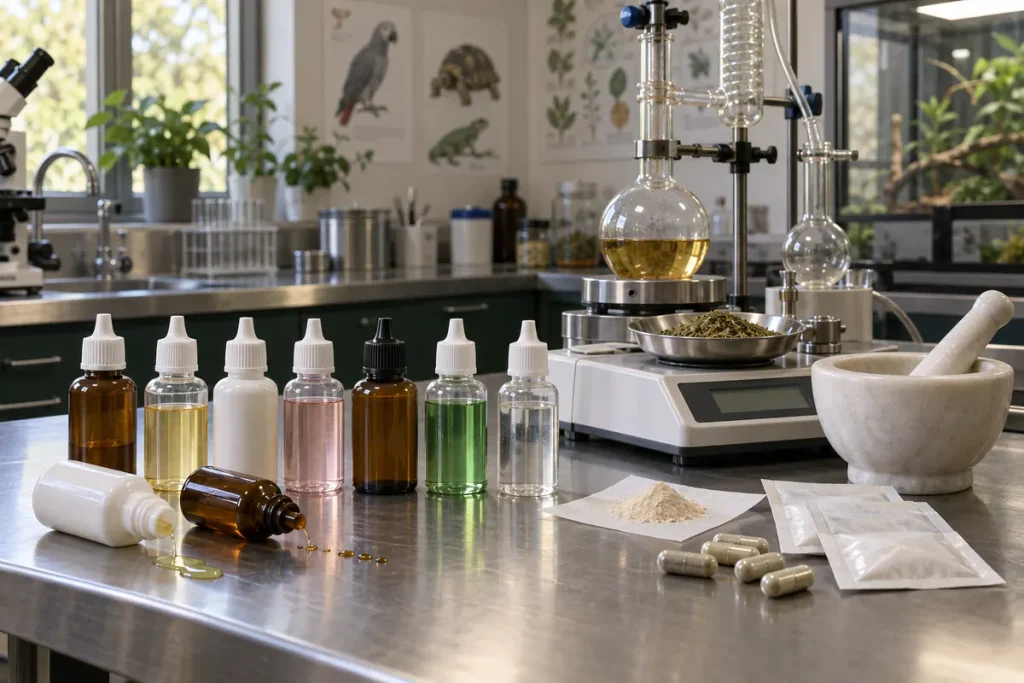
At Çeliktepe Veterinary Clinic, we prepare the necessary medications and supportive preparations for our bird and exotic animal patients, dosing them according to the patient’s needs and preparing them magistrally ourselves. We combine our clinical experience in bird and exotic animal medicine with our academic background in pharmacology; preparing vitamins, minerals, antimicrobial, and metabolic treatment preparations in concentrations and dilutions suitable for species, body weight, and treatment plan, delivering them fresh. During the preparation process, we evaluate the solubility of the active ingredient, the carrier used, the fat solubility and tissue distribution characteristics, conditions affecting absorption, and the method of administration together. Our goal is to support the expected benefit from treatment by selecting the appropriate form for the patient and facilitating correct application.
Treating a budgerigar, rabbit, or gecko is not merely about administering different amounts of medication. These animals have different digestive systems, metabolisms, feeding habits, and responses to medications. Therefore, drug selection, preparation, administration, and post-treatment follow-up must be considered as a whole.
What is magistral preparation?
Magistral preparation is the preparation of a medication in a specific dose, concentration, or pharmaceutical form tailored to a particular patient’s needs. Particularly in birds with small body weights and exotic animals with different physiological characteristics, the available presentation of ready-made products may not be suitable for the patient's use.
Dose refers to the amount of active ingredient to be given to the patient; concentration indicates how much active ingredient is present in a specific volume. Dilution is the process of making a solution under appropriate conditions. Each of these is important for accurately determining the amount the patient will receive.
Magistral preparation is not simply about reducing a tablet or adding water to a liquid. The properties of the active ingredient, compatibility with the carrier, homogeneity of the prepared form, and preservation of its properties during use should also be evaluated.
Why are species-specific medications used for birds and exotic animals?
A budgerigar, cockatiel, rabbit, hamster, guinea pig, chinchilla, hedgehog, gecko, and turtle are not small or large examples of the same treatment plan. Although they may display similar symptoms, their treatment needs may be different.
When creating a medication plan in our clinic, the following information is evaluated together:
- Type, age, and current body weight of the animal,
- Diagnosis and severity of the disease,
- Appetite, nutrition, and fluid intake,
- Conditions that may affect liver and kidney function,
- Medications, vitamins, and minerals used concurrently,
- Route of administration and owner's ability to administer.
It is not appropriate to directly apply the medication or amount used in another animal to a second animal with similar symptoms. Treatment is planned based on the patient’s own findings.
How does pharmacological knowledge impact the preparation process?
Veterinarian Miraç Gürbüz’s academic background in pharmacology is a crucial part of our clinic’s approach to medication evaluation and preparation.
We do not only look at which active ingredient is present in a preparation. We also assess how the active ingredient is presented, the suitability of the carrier used, and the compatibility of the route of administration with the patient's condition.
Solubility, homogeneous distribution, transfer to tissues, and absorption are related but not the same thing. The fact that a substance disperses in a liquid does not indicate that it is completely dissolved. Being dissolved does not necessarily mean that it will be absorbed at the same rate in every patient.
Therefore, we assess the form selection to ensure it provides the appropriate effect according to the patient's needs. Characteristics such as affinity for fatty tissue and water solubility gain meaning in conjunction with the targeted treatment and the patient’s physiology.
Why is bioavailability important?
Just because a medication or supplement has been given does not mean the active ingredient is being utilized in the body to the expected extent.
Bioavailability relates to the absorption of the active ingredient from the site of administration into circulation. The formulation of the preparation, route of administration, condition of the digestive system, and species-specific characteristics of the patient can all affect this process.
Our approach to preparation at the clinic aims to determine not only the appropriate dose for the patient but also the correct form and method of administration. By monitoring the response to treatment, we reevaluate the plan when necessary.
How do we plan vitamin, mineral, and other treatments?
We handle vitamin and mineral supplements with the same care as medications. The designation of a product as “vitamin,” “mineral,” or “support” does not mean it is necessary for every animal or appropriate in any amount.
Antimicrobials, metabolic treatments, and supportive preparations are evaluated based on examination findings and, when necessary, diagnostic investigations. The selected products are based on the patient’s needs; their concentrations and administration plans are prepared accordingly.
The goal of treatment is not to use as many products as possible. The aim is to deliver the necessary preparation to the right patient, in the appropriate amount, and by the correct method.
Why is saying “I already use this supplement” not sufficient?
We advise against assuming that every drug or supplement you use will provide the expected effect simply because it is marketed as “for birds.” Many products marketed as bird medications or supplements may not provide the expected benefit if not evaluated according to your bird's needs and appropriate usage conditions; they may only represent a financial burden.
The presence of the name of a vitamin on the product's packaging does not prove that the bird needs that vitamin or that it is receiving an adequate amount through the method used. Concentration, carrier system, storage conditions, and method of application are also important.
Similarly, having used a product for a long time does not prove that the expected benefit has been achieved. The patient’s condition and the suitability of the application should be evaluated together.
Why should medications or vitamins not be mixed casually into the water or food of birds?
In our clinic, we do not recommend mixing the patient-specific preparations we prepare for birds into drinking water or food outside of the indicated method. Such a change can obscure the preparation’s solubility, homogeneous distribution, and the amount the bird receives; it can affect the targeted treatment response.
The entire amount of a product added to the water may not be consumed by the bird. Daily water consumption can vary based on nutrition, environmental conditions, and health status. Especially when a sick bird drinks less water, the amount of the planned dosage received can become uncertain.
When mixed into food, the bird may not consume all of the feed. It may select certain parts, or a portion of the preparation may remain in the container and on uneaten food.
For this reason, saying “I put it in my water” or “I added it to my food” does not confirm that the required amount was applied.
The suitability of the carrier system used in fat-soluble vitamins is also important. Diluting the preparation outside of its own formulation or mixing it with other products can alter its properties. The issue will not be automatically resolved by simply administering an unsuitable formulation orally.
Direct oral administration can aid in controlling the given amount; however, absorption and treatment response must still be evaluated in conjunction with the preparation's properties and the patient's condition.
Why are fresh preparation and storage conditions important?
We deliver the preparations we prepare specifically for our patients fresh. Proper storage of the product under appropriate conditions after preparation is also part of treatment.
Temperature, light, the container used, and contamination that may occur during application can affect the properties of the preparation. Therefore, usage duration and storage conditions should be assessed according to the product.
Not every medication is stored in the refrigerator; not every liquid preparation is shaken in the same way. It is important for the owner to follow the instructions provided for the delivered product.
If an unexpected change in appearance, smell, or consistency is noticed, the clinic should be informed before continuing to use the product.
We explain the method of use clearly
Incorrect application of a properly prepared preparation can disrupt the treatment plan. Therefore, we explain the dosage, frequency of administration, and method of application clearly to the pet owner.
We consider it important for the pet owner to know the answers to the following questions:
- What amount should I use in the measuring tool provided?
- How will I administer the medication?
- How should I store it and for how long will I use it?
- What should I do if a dose cannot be administered?
- If a portion of the medication comes out, how should I proceed?
- In which changes should I inform the clinic?
If there is uncertainty about how much was taken, additional doses should not be given spontaneously. Any difficulties in application should be shared, and appropriate solutions for the patient should be determined together.
Our experience of over ten years and our pharmacovigilance approach
We do not evaluate medication safety solely at the preparation and delivery stages. Observations gained over more than ten years of professional experience and feedback from pet owners contribute to the evaluation of treatment responses, potential side effects, and drug interactions.
Our pharmacovigilance approach includes recognizing, assessing, and revisiting the treatment plan as necessary for unforeseen changes that occur after drug use.
Reporting changes in appetite, mobility, defecation, respiration, or behavior is therefore important. Whether a finding is related to the medication is assessed in conjunction with the course of the disease and other preparations used concurrently.
Patient-specific preparation, clear application training, and regular follow-up are the elements that complete the treatment in our clinic.
Frequently Asked Questions
What are budgerigar vitamins?
In the nutrition of budgerigars, fat-soluble vitamins such as A, D, E, and K, as well as B group vitamins, play crucial roles. Amino acids and minerals such as calcium, phosphorus, magnesium, and zinc are also considered. Amino acids and minerals are not vitamins; they are separate components that meet different nutritional needs.
This does not mean that each of these components needs to be provided as a supplement. Requirements are evaluated together with the bird’s diet, health status, and other products used. In our clinic, we prepare necessary vitamin, amino acid, and mineral preparations in appropriate concentrations and forms for the patient, explaining the method of application. The mere presence of the name of a vitamin, amino acid, or mineral on a product does not indicate that the bird has received an adequate amount or seen the expected benefit.
How are budgerigar medications chosen and prepared?
Budgerigar medications should not only be selected based on the name of the symptom; they should also be based on the bird's diagnosis, body weight, and general health condition. Since similar symptoms can be seen in different diseases, it should not be assumed that a product used in another bird will yield the same results.
In our clinic, we prepare the necessary preparations magistrally at appropriate doses, concentrations, and dilutions for the patient. We also assess the carrier system, solubility, and method of administration; explaining the method of use clearly.
Use of antibiotics in budgerigars
The selection of antibiotics for birds is based on the assessment of bacterial infections and the needs of the patient. Not every lethargy, vomiting, or change in feces requires antibiotics. When necessary, an appropriate treatment is determined by utilizing diagnostic investigations.
In our clinic, when antibiotics are required, we evaluate the bird's species, weight, existing diseases, and concurrently used preparations. We create a suitable preparation and administration plan for the patient. Diluting the prepared medication or mixing it in drinking water outside the specified method can alter the amount taken and the properties of the preparation.
How is an antifungal medication selected for a budgerigar?
Before selecting an antifungal medication for a budgerigar, it should be evaluated whether the symptoms are truly fungal in origin. Vomiting, delayed emptying of the crop, loss of appetite, and weight loss alone do not diagnose a fungal infection.
When antifungal treatment is deemed necessary, the active ingredient is selected based on the area of infection and the bird's condition. In our clinic, we assess the appropriate concentration, carrier, and route of administration during preparation. By monitoring the response to treatment, we readjust the plan as needed. For detailed information, you can refer to our article on crop mycosis in birds.
Is there a medication for diarrhea in budgerigars and other birds? How is medication selection made?
There are treatments for the cause of diarrhea; however, there is no single “diarrhea medication” that can be used for all birds and all cases of diarrhea. First, real diarrhea should be distinguished from increased liquid amounts in the feces.
Medication selection is made based on the cause of the fecal change and the general status of the bird. Simply thickening the feces does not indicate that the underlying problem has been resolved. Whether an antibiotic, antifungal medication, or another preparation is necessary is determined through examination and, if needed, investigations.
In our clinic, we prepare the necessary treatment in appropriate doses and forms for the patient; explaining the method of use and monitoring the response. Using a product sold as “for diarrhea” does not mean that the appropriate treatment for the issue in your bird has been applied. If changes in feces are accompanied by loss of appetite, significant lethargy, or blood, evaluation should not be delayed.
Can I mix my bird’s medication or vitamin into its drinking water or food?
Only apply the preparations prepared in our clinic using the specified method. Mixing casually into water or food may create uncertainty regarding solubility, distribution, stability, and the amount taken. The quantity added to water is not the same as the amount your bird actually consumes.
If I am already using the same vitamin, does it need to be re-evaluated?
Yes. Using a product does not mean the need is met or that the expected benefit has been achieved. The product's formulation, concentration, method of application, and the patient’s condition should be evaluated together.
Can I give the medication prepared for my bird to another bird?
Even if the same symptoms are observed, do not give it spontaneously. Diagnosis, body weight, and treatment needs may be different. A preparation specially made for one patient may not be suitable for another bird.
Why is magistral medication given in different amounts?
The volume to be applied depends on the concentration of the preparation. Two bottles may look similar, but they can contain different amounts of active ingredient in the same volume. Therefore, do not apply the dosage from a previous medication to a new preparation.
Can the concurrent use of vitamins and minerals cause issues?
Yes. One or more products may contain the same component, or concurrent use may affect the treatment plan. Do not combine products spontaneously.
If some of the medication comes out after administering it, should I give it again?
Do not give additional doses without knowing how much was taken. Report the situation to the clinic to receive specific guidance for your patient.
How long can I use a freshly prepared preparation?
The usage duration varies according to the preparation. Follow the specified duration and storage conditions provided upon delivery. Do not use the remaining product for a later illness without consultation.
Are magistral medications completely free of side effects?
Every treatment is evaluated based on the patient's condition. Appropriate medication selection, proper preparation, clear application instructions, and follow-up are all important for managing potential risks. If any unexpected changes occur, the clinic should be informed.
Patient-specific treatment for birds and exotic animals in Istanbul
At Çeliktepe Veterinary Clinic, we approach the medication preparation process together with examination, diagnosis, application training, and treatment follow-up.
For our bird patients, you can check our services as Istanbul Bird Veterinarian, and for our rabbit, small mammal, and reptile patients, as Istanbul Exotic Animal Veterinarian.
For examination and information, you can contact us at 0212 923 10 24.

