
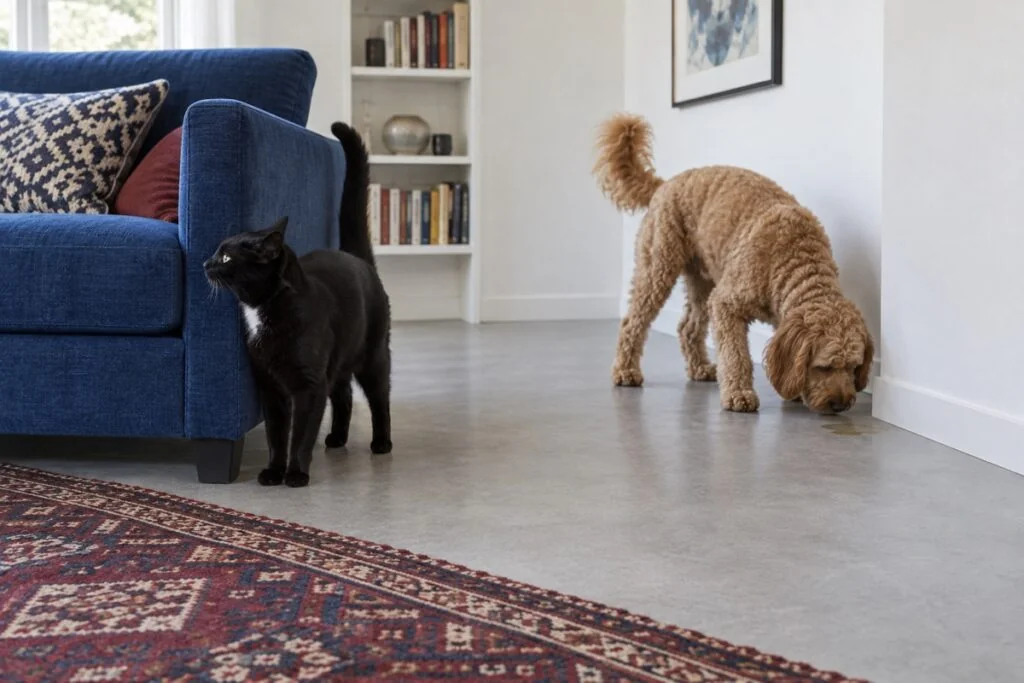
A few drops appearing at the same spot next to the door, a sharp smell coming from the edge of the couch, or a previously well-trained dog starting to urinate on the carpet… It is easy to explain these changes in the home as mere "grumpiness." However, urination marking, inappropriate elimination, and involuntary urine leakage are different issues that require different solutions.
If your pet is trying to urinate repeatedly but cannot, only producing a few drops, or if it is accompanied by pain and agitation, do not wait. Urinary obstruction in male cats can pose a life-threatening risk. Seeing a few drops of urine does not rule out obstruction. In this case, not behavioral training, but emergency veterinary assessment is required. Cornell Feline Health Center
Is It Marking, Toilet Problem, or Incontinence?
Cats typically stand while marking, raise their tails, and urine a small amount on vertical surfaces like walls, doors, or the edges of objects. Tail quivering may be observed. However, some cats may also mark horizontal surfaces; a definite conclusion cannot be made solely by looking at the location of the stain. Squatting outside the litter box to urinate more can suggest a toilet problem. Merck Veterinary Manual
In dogs, leaving small amounts of urine in different spots may be marking behavior. This behavior is not seen only in males; females and spayed dogs can also mark. Producing enough urine to empty the bladder may be related to walking habits or toilet training, but can also indicate illness. VCA: Marking in Dogs
Leaving wetness where they sleep, dripping when getting up, or involuntary leaking of urine indicates incontinence. It would not be correct to interpret this as “learning to urinate in the house.” Merck: Disorders of Urination
Why Did It Start Now If It Didn’t Before?
First, Assess for Pain and Disease
Bladder pain, stones, and lower urinary tract diseases in cats can frequently lead to increased trips to the litter box or urinating outside the box. Not every urination problem is due to a bacterial infection. Increased water intake and urine volume may indicate various problems, such as kidney disease or diabetes. A cat that has a painful toilet experience may associate that discomfort with the litter box and choose another location. Cornell: Urinating Outside the Litter Box
Therefore, in cases of sudden onset or recurring issues, the first step is general examination and internal medicine evaluation. Age, spaying status, medications used, and when symptoms began are all considered together.
Changes at Home and Sense of Security
Moving, bringing a new pet home, seeing other cats outside the window, or changes in daily routine can trigger marking. Tension can occur between cats in the same household without open conflict; one cat blocking the other’s access to the litter box is an example of this. Marking under these conditions is a communication behavior. Its presence alone does not necessarily mean there is a behavioral disorder in the animal. Merck: Behavioral Problems in Cats
In dogs, insufficiently established toilet training, not being able to go outside for a long time, or anxiety are among the factors that are examined separately. If the problem occurs only when left alone at home, whether it is accompanied by barking, scratching at the door, or intense agitation is also important. A single urination accident does not diagnose separation anxiety. VCA: House Soiling in Dogs
How Do Estrus and Hormones Affect Marking?
In unneutered animals, hormonal effects related to reproduction can increase marking. Female cats may leave scent with their urine during their estrus period. Male cats may also mark due to sexual motivation; however, male cats and dogs do not go through estrous cycles like females. They may respond to the scents of female cats in heat and other stimuli. VCA: Marking and Spraying in Cats
Can Repeated Behavior Become Permanent?
Marking that begins during estrus and continues for a long time can become habitual in some animals, persisting even after the hormonal period ends. The lingering scent in the same spot, ongoing stress, and learned behaviors can sustain the problem. Therefore, waiting for months with the belief that "it will improve once estrus is over" can delay the necessary behavioral and environmental adjustments for resolution.
The potential for permanence here does not mean that irreversible damage will occur in every animal. A long-standing habit can be corrected with appropriate assessment and follow-up; however, simply eliminating hormones is not always sufficient. VCA’s Guide to House Soiling emphasizes that the habit can persist even when underlying factors are addressed.
Persistent Estrus Signs Should Also Be Investigated
Estrus periods in female cats can follow one another. However, symptoms that last longer than usual or seem to never stop should not be treated merely as a behavioral problem. Particularly in prolonged estrus, ovarian cysts and hormonal causes may be investigated. The normal cycle, recurring cycle, and genuinely prolonged estrus can be distinguished through examination. Merck: Follicular Cysts in Small Animals
Does Neutering Completely Solve the Problem?
Neutering may reduce hormone-related marking. However, not every complaint of urinating in the house is due to hormones; pain, anxiety, environmental triggers, or established habits may persist. In dogs, the causes of behavior and its learned aspects are also taken into account. VCA: Neutering and Dog Behavior
Thus, it is not correct to promise that "it will definitely stop the day after surgery." The neutering plan is developed considering the animal's species, age, health status, and reproductive history. If necessary, environmental adjustments and behavioral follow-ups are included in the same plan.
Is A Strong Urine Odor a Sign of Disease?
The odor of urine can vary depending on its concentration and composition. Urine from unneutered male cats can have a distinctly strong odor. However, a strong odor alone does not diagnose an infection; a faint odor does not prove that the urinary tract is healthy. Merck: Urinalysis
If a new change in odor is accompanied by blood, increased frequency of urination, straining, excessive licking of the genital area, or increased water intake, an examination is necessary. Depending on the veterinarian’s findings, urinalysis and necessary laboratory tests may be planned. If a bacterial infection is suspected, appropriate samples for culture may be requested; antibiotics should not be started based on odor alone.
What Adjustments at Home Can Help?
- Make it easier for the cat to access the litter box. The general starting recommendation is one more litter box than the number of cats. Instead of placing the boxes side by side, place them in calm and different access points. The size of the box, its cleanliness, and the cat's ability to comfortably enter and exit are important. Strongly scented litters may deter some cats.
- Organize toilet opportunities for the dog. Provide regular outdoor access; reward immediately and calmly when it toilets in the correct place. Expecting it to hold it for a long time can worsen the problem.
- Clean the soiled area with an appropriate product. Use a product suitable for use in areas frequented by pets according to its label for urine odor. Simply masking the odor with perfume is not sufficient. Do not mix cleaning chemicals.
- Do not punish. Yelling or rubbing its nose in the urine does not solve the problem; it can increase fear and tension.
- Keep a short log. Note the time, place, amount, posture, and changes experienced before the incident. A short video taken without disturbing the animal can be helpful during the examination.
For litter box placement and cleaning, Cats Protection Litter Guide; for approaches to marking, Cats Protection Spraying Guide offer additional information. These adjustments should not be used to delay assessing the potential for disease.
Frequently Asked Questions
Could my cat be urinating on my bed because she is angry with me?
Interpreting this as revenge is not a correct starting point. Pain, stress, litter box issues, and surface preferences should be assessed. If a previously absent behavior has started, do not delay examination.
Do female or spayed animals also mark?
Yes. Marking is not exclusive to unneutered males. The animal's sex and neutering status are important clues, but they do not indicate the cause alone.
Is it normal for her to leave a scent after the heat has passed?
The behavior may have become a habit; stress or a medical issue may still be ongoing. Instead of assuming it is permanent and unsolvable, the cause should be reassessed.
Does mating once solve the problem?
Mating is not a treatment for marking or urinating in the house. It does not guarantee permanent correction. A breeding and behavior plan should be discussed with a veterinarian.
If the amount of urine has decreased, should I give her more water?
Fresh water should always be available; however, expecting a pet that struggles to produce small amounts of urine or cannot produce any to drink is not safe. Immediate examination is necessary, especially for male cats. Do not restrict water to reduce urination accidents.
Can I use antibiotics at home for the bad odor?
No. Odor does not prove infection. Improper medications can delay understanding the real cause; treatment is determined based on examination and, if necessary, urine analysis.
Examination and Follow-Up at Çeliktepe
The goal in complaints of urinating around the house is not only to eliminate the odors but to find out why the behavior started. When coming for examination, sharing the onset of symptoms, history of estrus or spaying, and changes in household routine facilitates assessment.
Çeliktepe Veterinary Clinic — Veterinarian Miraç Gürbüz
Çeliktepe Mahallesi, Buhara Sokak No:8/A, Kağıthane / İstanbul
Phone: 0212 923 10 24
For appointment scheduling and directions, you can visit our contact page.
This article is for general information purposes. Diagnosis and treatment plans based on your pet's symptoms are determined through veterinarian examination.

